
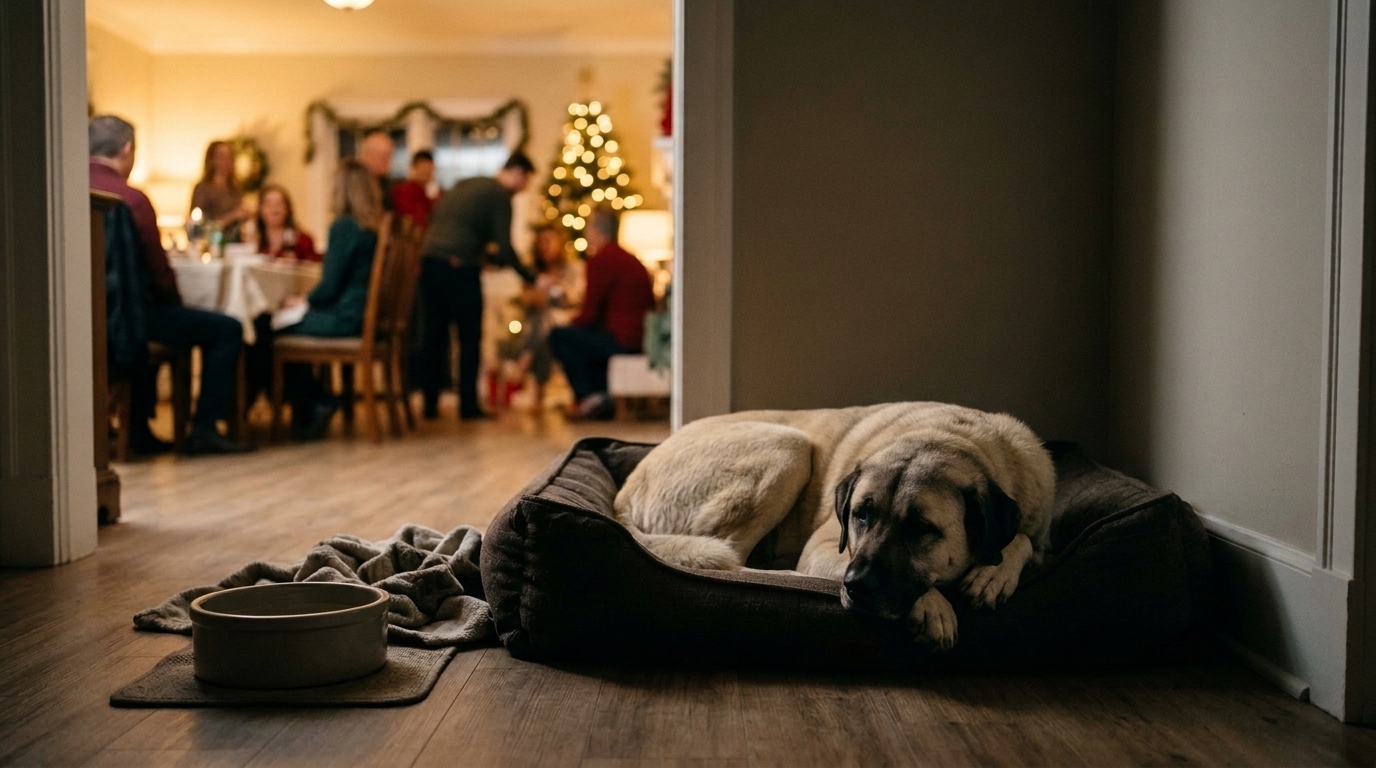
Why gatherings can be challenging for dogs
Visitors and noise can raise stress
The American Veterinary Medical Association notes that visitors, noise, and the excitement of holiday parties can make pets nervous, including pets that are usually comfortable around people. The Centers for Disease Control and Prevention explains that dogs may bite when scared, nervous, eating, playing, guarding toys or puppies, or feeling unwell. These are reasons to manage the setting, not reasons to blame a dog for communicating discomfort.
Watch for a dog that hides, stiffens, growls, or moves away. Give it space and end the interaction rather than asking guests to approach, pet, or coax it. The AVMA’s winter holiday pet-safety guidance recommends a quiet place where pets can retreat and guests will not follow.
Children and food need clear boundaries
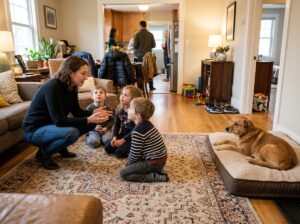
Young children may move quickly, make sudden noises, or miss a dog’s signals. The CDC says adults should always supervise young children around dogs, even familiar family pets. Keep children away from a dog that is eating, sleeping, resting with a toy, or trying to retreat. Do not leave a child and dog together while adults are busy serving food or greeting visitors.
Holiday meals also create more chances for a dog to reach food or for a guest to offer an unapproved treat. Food can be a guarding trigger, and some holiday foods are unsafe for pets. The ASPCA’s 2025 Thanksgiving safety tips recommend keeping pets comfortable around guests and preventing access to risky foods. For general child-safety guidance, see Dog-Bites.net’s article on protecting children from dog bites.
Make a plan before guests arrive
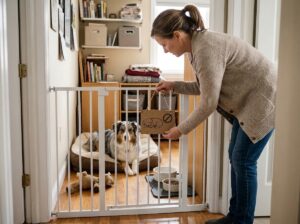
Set up a quiet retreat
Choose a room or secure area where the dog can relax away from the gathering. Add water, a comfortable bed, and familiar toys. Put up a simple note asking guests not to enter. If the dog is comfortable in a crate, it can be another retreat, but it should not be used as a punishment. Make the space available before the house becomes busy so the dog can settle on its own terms.
Decide in advance which adult will check on the dog and manage the door. A child should not be responsible for supervising or moving the dog. If your dog has a known fear, bite history, or difficulty with visitors, consult your veterinarian or a qualified behavior professional before hosting. Consider keeping the dog separated for the entire event if that is the safest plan.
Tell guests the rules in advance
Let guests know there is a dog in the home and explain the boundaries before they arrive. Ask them not to feed the dog, hug it, wake it, crowd it, or approach it in its retreat area. Give children a short rule they can remember: ask an adult before approaching, and leave the dog alone when it is eating or resting. Adults should step in instead of relying on children to read dog body language.
Ask visitors whether they plan to bring a dog. If the animals have not met or you do not know how they respond to each other, it may be safer to decline the extra pet. If you decide on an introduction, supervise closely, keep an exit route open, and separate the dogs at the first sign of tension. Do not force animals to share food, toys, beds, or a crowded room.
Reduce risk while the gathering is underway
Manage doors, food, and activity
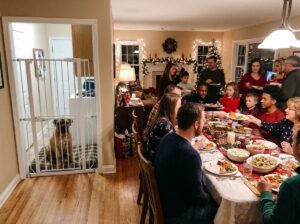
Holiday arrivals and departures can leave doors open. Use a closed interior room, secure gate, or leash held by a responsible adult so the dog cannot slip outside or rush a guest. Tell visitors to wait for the host before entering if the dog is near the door. Check that gates latch and that the dog cannot get through an open doorway while coats and bags are being carried in.
Keep serving dishes, bones, wrappers, and trash out of the dog’s reach. Ask guests not to pass table scraps or hand treats to the dog. If the dog is near food, toys, or its resting place, do not let guests reach over it or try to take an item away. A calm separation is safer than testing whether the dog will tolerate an interaction.
Pause contact when the dog needs space
Supervision means an attentive adult is close enough to intervene, not simply in the same house. End petting when the dog turns away, retreats, becomes tense, or growls. Do not scold a dog for warning signals; move people away and give the dog a quiet break. Dog-Bites.net’s general guide to preventing dog bites offers more everyday advice on safe interactions.
Understand owner responsibility and insurance
If a dog bites a guest, the dog owner may face a claim under state dog-bite law. The legal standard, available defenses, and deadlines vary by state. Liability may depend on the dog’s history, the victim’s conduct, the location, and what the owner knew or did. A host who does not own the dog is not automatically responsible, but facts about control, warning, or unsafe conditions can matter. The dog owner and any homeowner or renter should preserve the details and avoid assuming that one rule applies nationwide.
Homeowners and renters policies often include personal-liability coverage for dog-bite claims, but policy terms, limits, exclusions, and insurer practices differ. Some insurers may exclude a dog, apply conditions, or respond differently after a previous bite. The Insurance Information Institute summarizes dog-bite liability and homeowners or renters insurance. Do not treat a policy as guaranteed coverage; check the actual contract and contact the insurer with questions before a gathering. For a broader overview of state rules, read Dog-Bites.net’s guide to who may be liable for dog-bite injuries.
What to do if a bite happens
Separate the dog from people without putting yourself at risk. Get appropriate medical care and follow advice about wound treatment and rabies concerns. The CDC recommends reporting dog bites to local animal control or police. If possible, identify the dog and owner and ask for current rabies vaccination information.
Write down what happened while memories are fresh. Record the time, location, people present, what the dog was doing, and any steps taken before the bite. Save photographs, witness contact details, medical records, and relevant messages. The owner should review the policy and give notice to the insurer if required. Do not speculate publicly or sign a release before understanding its terms.
Liability depends on local law and the full circumstances, not simply on the fact that a guest was bitten. Dog-Bites.net’s guide to filing a dog-bite claim covers general documentation steps. A qualified local attorney can explain how the law applies to a specific situation.